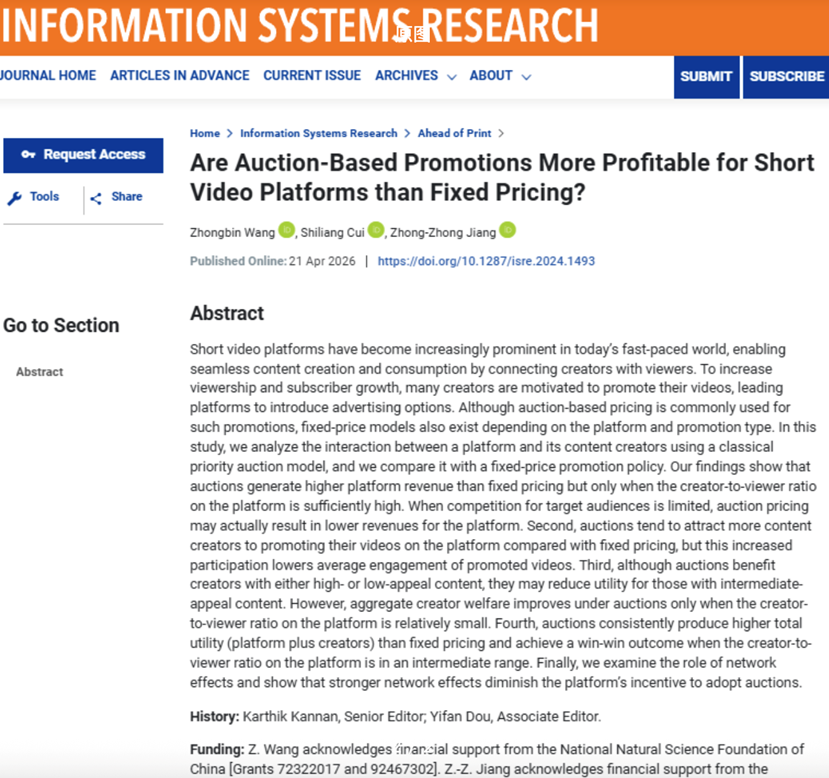
Recently, the research team of Professor Jiang Zhongzhong from the School of Business Administration, NEU (sole corresponding author), together with Professor Wang Zhongbin from Tianjin University and Professor Shiliang Cui from Georgetown University, published research achievements in the UTD24 top international journal Information Systems Research (abbreviated as ISR) titled "Are Auction-Based Promotions More Profitable for Short Video Platforms than Fixed Pricing?" This represents a significant milestone, as it is the first time NEU faculty have published in ISR.
Short video platforms have become an important vehicle for service operation in the digital economy, yet the pricing of content promotion mechanisms remains a core issue affecting platform revenue and ecosystem efficiency. To systematically examine the comparative effectiveness of auction versus fixed-pricing mechanisms in short video platform promotion services, this paper constructs a two-sided market analysis framework, conducting comparative analysis from three dimensions: platform revenue, creator behavior, and social welfare. Methodologically, the paper innovatively introduces a priority queue auction model to characterize core features such as continuous content emergence, dynamic adjustment of recommendation ranking, and intense competition among creators. Compared to traditional Generalized Second Price (GSP) or Vickrey-Clarke-Groves (VCG) mechanisms, this model is more aligned with the highly dynamic and competitive environment of short video platforms. The research analyzes two market structures: "low creator-to-viewer ratio" and "high creator-to-viewer ratio." A "low creator-to-viewer ratio" indicates relatively moderate platform competition with ample content exposure opportunities; "high creator-to-viewer ratio" more closely reflects the reality of mature platforms, where the number of creators is vast, viewer attention is scarce, and competition is fierce. The study finds that auction mechanisms have a significantly differentiated impact on creators, benefiting creators of high-appeal and low-appeal content, while creators of intermediate-appeal content may face revenue compression. In a comprehensive comparison of the two mechanisms, the study finds that auction mechanisms can achieve a "win-win" for platform revenue and total utility of creators when the creator-to-viewer ratio is in the medium range. This conclusion challenges the intuitive notion that platform revenue growth necessarily comes at the expense of creator welfare and provides cutting-edge insights from an academic perspective for the scientific design of platform pricing strategies. Looking to the future, platform managers, creators, and regulatory agencies need to collaboratively advance platform governance, continuously improve pricing mechanisms, and make them a key tool for promoting content ecosystem prosperity and high-quality platform development.
Information Systems Research (ISR) is recognized as a premier international journal in the field of information systems, published by the Institute for Operations Research and the Management Sciences (INFORMS). It is included in the UTD-24 and FT-50 journal lists and is recognized as one of the highest-level academic journals globally by business schools, enjoying a high academic reputation in the international management community. The journal is dedicated to publishing innovative and high-level research achievements in the intersection of information systems and management sciences, focusing on the significant impact of various information systems on enterprises, organizations, and society.
This research achievement was supported by the National Natural Science Foundation of China's Major Research Plan Key Project "Research on Networked Collaborative Decision-making Theory and Methods for Human-Machine Hybrid Groups" (92567205), the National Natural Science Foundation of China's Excellent Young Scientists Fund Project "Stochastic Service Operation Management" (72322017), and the Major Project of National Social Science Foundation "Resilience Assessment and Countermeasure Research on Key Industry Supply Chains under Major Emergency Situations" (23&ZD050). It reflects a significant focus on national strategic needs and the international academic frontier, deepening interdisciplinary research, promoting high-level international cooperation, and enhancing original research capabilities. This will provide strong support for the "Double First-Class" initiative of the university and the high-quality development of the college's disciplines.