Recently, the research group of Professor Dake Xu within the team led by Professor Fuhui Wang at the School of Materials Science and Engineering, NEU, made a breakthrough in the field of intelligent antifouling coatings. The related research achievement, titled "Jellyfish-Inspired Hydrogels Enabling Synergistic Antifouling and Low-Drift for Transformer-Assisted Multimodal Marine Bioelectronics," was published in Advanced Materials (DOI: 10.1002/adma.74213), a top international journal in the discipline of materials science. Associate Researcher He Liu (College of Medicine and Biological Information Engineering) is the first author, while Professor Dake Xu, Researcher Ye Tian (College of Medicine and Biological Information Engineering), and Researcher Xiangyu Li are the co-corresponding authors. NEU is the lead institution and the sole corresponding institution.
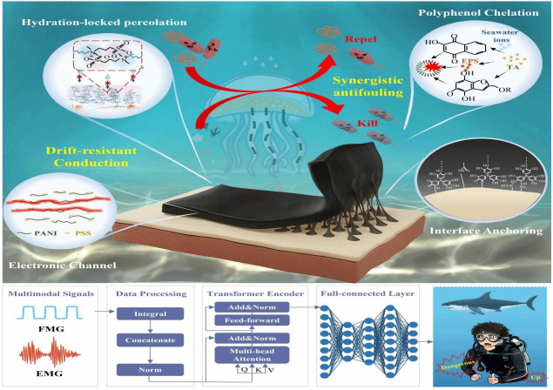
Schematic illustration of biomimetic intelligent hydrogels for synergistic antifouling and low-drift marine bioelectronics
As a soft and easily functionalized materials, hydrogels exhibit significant application potential in intelligent antifouling coatings and marine bioelectronic interfaces. However, in seawater environments, they still face challenges such as interfacial biofouling, performance drift caused by high salinity-induced swelling, and the difficulty of stably decoding signals under complex noise backgrounds. To address these challenges, this study proposes a hydration-locked percolation strategy to construct a jellyfish-inspired, high-performance hydrogel antifouling interface material, successfully integrating synergistic antifouling, drift-resistant conductivity, and artificial intelligence-assisted multimodal sensing functions. By constructing a hydration-polyphenol network, this material effectively inhibits non-specific bioadsorption and early biofilm formation, thereby creating a synergistic antifouling system with both repellent and killing effects. Leveraging cross-substrate wet adhesion and local swelling suppression to stabilize the electronic percolation pathways within the material, the system achieves a long-term stable, high conductivity (electrical conductivity of 22 S m⁻¹) in seawater environments while enabling physiological signal acquisition with high signal-to-noise ratios. Furthermore, a multimodal intelligent decoding framework merging a Transformer encoder and a multilayer perceptron was constructed, which is capable of capturing long-range temporal dependencies and cross-modal correlation information in complex signals, thereby achieving accurate recognition of multimodal physiological signals (with an accuracy rate of 98.5%). Combining biomimetic antifouling material design, stable conductive interface construction, and artificial intelligence signal decoding, this study provides new insights for developing intelligent antifouling coatings, flexible sensing interfaces, and long-term stable marine bioelectronic systems for use in marine environments.
The above work was supported by the National Science Fund for Distinguished Young Scholars, the National Key R&D Program of China, the National Natural Science Foundation of China, the Open Research Fund of the State Key Laboratory of Advanced Marine Materials, the postdoctoral funding projects of the China Postdoctoral Science Foundation, the Doctoral Start-up Foundation of Liaoning Province, and the Fundamental Research Funds for the Central Universities.


