Recently, doctoral candidate Zhang Jun from the School of Materials Science and Engineering, NEU, made a breakthrough in the research of anode materials for lithium metal batteries. The related research achievement, titled “Beyond Isolated Active Sites: Adjacent Single‑Atom‑Nanoparticle Electronic Coupling Enables Lateral Lithium Growth,” was published in the top‑tier international materials journal Advanced Materials. This study proposes a synergistic regulation strategy for adjacent cobalt single atoms and nanoparticles, which utilizes the gradient of interfacial local adsorption energy to guide subsequent lithium to preferentially occupy adjacent sites and shift the lithium‑deposition mode from local vertical accumulation to lateral growth. The Analytical and Testing Center, NEU provided important support for characterization tests in this work, including the Cs‑corrected transmission electron microscope.
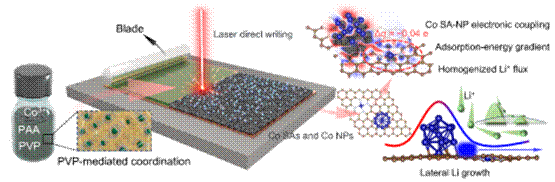
To address the above issues, the previous step involved constructing an integrated lithium host based on Cobalt single atom–nanoparticle/nitrogen-doped porous graphene. By regulating the adjacent distribution of Co single atoms and nanoparticles, the study established a local Li adsorption‑energy gradient through interfacial electronic‑structure reconstruction. This approach enabled subsequent Li to preferentially occupy adjacent single‑atom sites rather than vertically accumulate along the initial Li nuclei, thereby realizing the transition of lithium deposition from local vertical growth to lateral expansion. This research extends lithium‑host design from the number and adsorption strength of isolated active sites to the spatial arrangement of adjacent sites and the distribution of local adsorption energy. It provides a new material‑design idea for regulating lithium‑deposition direction and suppressing local vertical accumulation.


